A step does one part of a run: a model call, a check, a program to
run, or a stage of the document layer. hr_chain() runs
steps in order as one arm. That arm is an ordinary
hr_arm(), so hr_benchmark() compares it with
recipes and with other chains on the same labelled questions, as
vignette("compare") does for recipes. A recipe such as
needle runs a fixed sequence of stages: segment the
document, rank the chunks, read the best. A chain can add what a recipe
lacks, such as a check after the answer or a step that rewrites the
question.
Steps and chains are part of the core. Most examples below chain the
document layer’s stages over the example report, because a short
document makes each step’s input and output easy to see. The coding
sub-agent near the end reads no document. A step makes its requests
through its ctx, so the trace, the limits and the cache
apply to them as to any call (vignette("core") and
vignette("runs")).
hr_chain() passes each step’s output to the next step. A
step’s settings come from its schema and reach it as
ctx$step_params. No step that is not held may follow a held
command step:
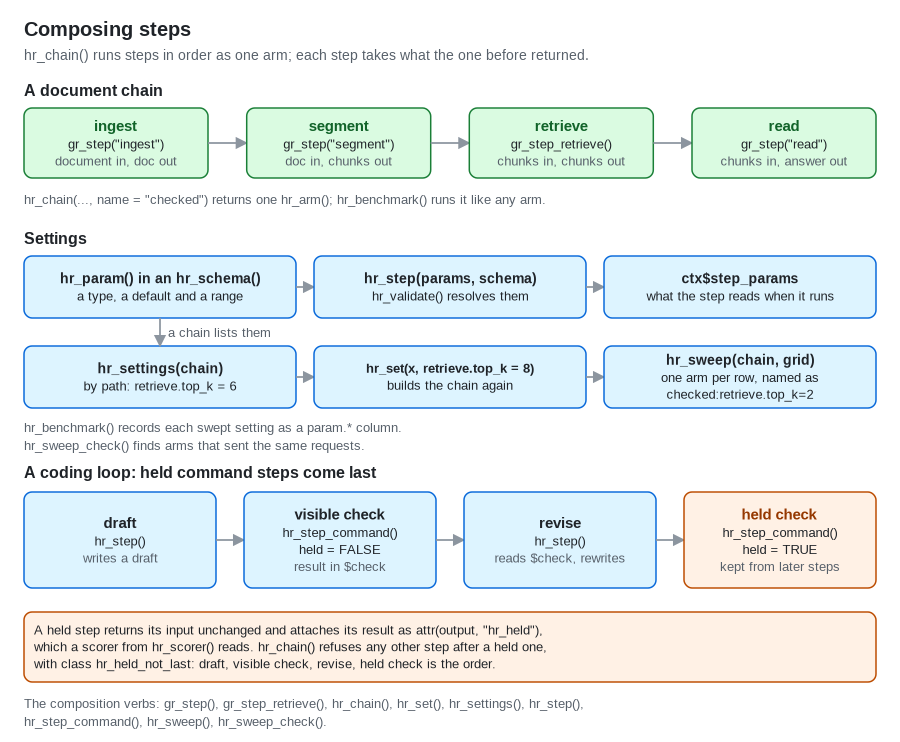
Everything here runs offline on a stand-in model.
library(harnessr)
old <- hr_options(verbose = FALSE, embedder = "lexical")
cl <- hr_mock_client(function(messages, params) {
  if (grepl("You grade one response", messages[[1]]$content, fixed = TRUE)) {
    return('{"verdict": "pass", "reason": "It gives the figure."}')
  }
  "Revenue was 45.2 million dollars."
})
ref <- gr_qa_reference(
  questions = c(revenue = "What was revenue in 2024?"),
  documents = gr_example(), answers = list("45.2 million"), split = "test")
Steps
A step is a function of (input, ctx) that does one part
of a run. gr_step() builds a step for a document stage:
"ingest", "segment" or "read".
gr_step_retrieve() builds a step that ranks the chunks and
keeps the best without asking for an answer. Both take the settings the
stage’s spec takes, and both check them when they build the step:
gr_step_retrieve(top_k = 4)
#> <gr_step> retrieve (retrieve): top_k=4
try(gr_step("read", reader = "no_such_reader"))
#> Error in registry_get("reader", spec$reader) :
#>   Unknown reader 'no_such_reader'. Registered: ensemble, extract, hierarchical, iterative, map_reduce, preview, refine, rerank, retrieve, screen, skim, stuff.
hr_step() builds a step of your own. Inside a chain,
ctx is the context that hr_benchmark() gives
an arm: its client, its trace, the judge and
note shortcuts, and params.
ctx$step holds the step’s name and
ctx$step_params its settings. The step below grades the
answer with a model and records the verdict as a signal of the run:
judge <- hr_step("judge", function(a, ctx) {
  j <- ctx$judge(a$answer, mode = "grade", reference = "45.2 million",
                 rubric = "Does it give the figure?", orders = 1)
  ctx$note("judged", j$verdicts$verdict[1])
  a
}, input = "answer", output = "answer")
The optional input and output arguments
declare what a step takes and returns: "document",
"doc", "chunks", "answer" or
"state". hr_chain() uses them to check the
order of the steps.
Chains
hr_chain() runs its steps in order. The first step gets
the item, each later step gets what the step before it returned, and the
chain returns what the last step returns. The name you give each
argument is that step’s name in the chain.
checked <- hr_chain(segment = gr_step("segment"),
                    retrieve = gr_step_retrieve(top_k = 4),
                    read = gr_step("read", reader = "stuff"),
                    judge = judge, name = "checked")
checked
#> <hr_arm checked> version 0.0.1
#>   params: retrieve.top_k = 4, read.reader = stuff
#>   hash: fb6871699ea5
The arm records each step’s settings as "step.setting",
so a benchmark of checked has a
param.retrieve.top_k column. To derive one chain from
another, pass the old chain and name the steps to change:
-
NULLdrops a step. - A step under an existing name replaces that step where it stands.
- A step under a new name goes at the end.
nojudge <- hr_chain(checked, judge = NULL, name = "nojudge")
wider <- hr_chain(checked, retrieve = gr_step_retrieve(top_k = 8), name = "wider")
names(attr(wider, "hr_steps"))
#> [1] "segment"  "retrieve" "read"     "judge"
The three chains run side by side like any other arms. Each run sends
its requests at its own draw, so a cache does not hand one run’s reply
to the next (“Repeated draws” in vignette("runs")):
bench <- hr_benchmark(list(checked, nojudge, wider), ref, runs = 5, client = cl,
                      scorer = gr_scorer_answer())
aggregate(correct ~ arm + param.retrieve.top_k, bench, mean)
#>       arm param.retrieve.top_k correct
#> 1 checked                    4       1
#> 2 nojudge                    4       1
#> 3   wider                    8       1
head(hr_signals(bench, "judged")[, c("arm", "run", "item", "value")], 3)
#>       arm run    item value
#> 1 checked   1 revenue  pass
#> 2 checked   2 revenue  pass
#> 3 checked   3 revenue  pass
What a chain checks when it is built
hr_chain() warns with class hr_chain_gap
when a step takes chunks and no step before it returns them. Without the
warning, a read step would cut the document at the default settings
without saying so. A segment step first in a chain does not warn, though
it reads the document at the default ingest settings; put an ingest step
before it to choose them.
After a step that returns the answer, only steps that take
"answer" or "state", or declare nothing, can
follow.
tryCatch(hr_chain(read = gr_step("read", reader = "stuff"), name = "gap"),
         hr_chain_gap = function(w) conditionMessage(w))
#> [1] "Chain 'gap': step 'read' takes chunks, but no step before it returns them, so it will cut the document into chunks at the default settings. Add a segment step before it to choose them."
try(hr_chain(segment = gr_step("segment"), read = gr_step("read", reader = "stuff"),
             retrieve = gr_step_retrieve(), name = "late"))
#> Error in chain_check_order(steps, what) :
#>   Chain 'late': step 'retrieve' takes "chunks", but it comes after step 'read', which returns the answer. After an answer only steps that take "answer" or "state" can follow.
Step names cannot repeat, and they cannot contain a dot, because
settings are named "step.setting".
When two chains are the same
A chain’s configuration is a hash of its steps’ code, the values that
code reads, and their resolved settings. Two chains with the same
configuration send the same requests, and hr_benchmark()
warns with class hr_same_config when you ask it to compare
them. A setting given at its default gives the same configuration as the
setting left out:
a <- hr_chain(segment = gr_step("segment"), retrieve = gr_step_retrieve(), name = "a")
b <- hr_chain(segment = gr_step("segment"), retrieve = gr_step_retrieve(top_k = 6),
              name = "b")
identical(attr(a, "hr_config"), attr(b, "hr_config"))
#> [1] TRUE
Registering a step
hr_register() files a module in the registry under a
kind. The kinds are "extractor", "cleaner",
"segmenter", "reader",
"embedder", "protocol" and
"step". The first six belong to the document layer, and
vignette("extending") registers them. For any other kind,
hr_register() raises an error of class
hr_unknown_kind.
A step from hr_step() registers under the kind
"step". Its version is the step’s own unless you give
hr_register() another:
hr_register("step", "shout", fn = hr_step("shout", function(input, ctx) toupper(input),
                                          input = "answer", output = "state",
                                          version = "0.2.0"))
hr_modules("step")[, c("name", "input", "output", "version", "contract")]
#>    name  input output version contract
#> 1 shout answer  state   0.2.0      0.2
hr_modules() with no kind lists the modules of every
kind in one table, with the call stems each declares as a list column.
Give it a kind, as above, to add that kind’s own columns:
m <- hr_modules()
table(m$kind)
#>
#>   cleaner  embedder extractor  protocol    reader segmenter      step
#>        14         2         6         4        12         9         1
Checking a module
hr_check_module() runs a module once and reports which
of your rules it breaks. It works for a module of any kind. Give it
three things:
- the module’s function;
- a closure of no arguments that runs the module once;
- a named list of rules, each a function of the value the closure returned.
A rule returns TRUE, FALSE, NA
(could not be checked), or a list with ok and a
detail string. The closure runs in a temporary working
directory that hr_check_module() removes afterwards, and
the runs rule reports any error the closure raises.
double_it <- function(x) x * 2
hr_check_module(double_it, function() double_it(2),
  rules = list(numeric = function(v) is.numeric(v),
               above_three = function(v) list(ok = v > 3, detail = sprintf("got %s", v))),
  kind = "function", name = "double_it")
#> <hr_conformance> function 'double_it', contract 0.2
#>   passes all 4 rules
#>   ok    is_function
#>   ok    runs
#>   ok    numeric
#>   ok    above_three: got 4
The reader and segmenter checks of the document layer use it
(“Checking a module against the contract” in
vignette("extending")).
Settings and sweeps
Every step built with a schema has settings:
- a
gr_step()step has the settings the stage’s spec takes; - a
gr_step_retrieve()step has the ranking settings; - a step of your own has the settings its
schemadeclares.
In a chain, each setting is named by its path,
"step.setting". hr_settings() lists them all.
For each one it gives the value the step resolved, whether you gave it,
and the default, range and evidence the schema declares:
s <- hr_settings(checked)
nrow(s)
#> [1] 71
s[s$set, c("step", "param", "value", "default", "range")]
#>        step  param value    default      range
#> 21 retrieve  top_k     4          6 [1, 10000]
#> 35     read reader stuff map_reduce
s[s$step == "retrieve", c("param", "value", "range", "status")]
#>            param   value       range   status
#> 21         top_k       4  [1, 10000] untested
#> 22     min_score    -Inf             untested
#> 23           mmr       1      [0, 1] untested
#> 24       bm25_k1     1.5     [0, 10]    cited
#> 25        bm25_b    0.75      [0, 1]    cited
#> 26 lexical_blend     0.5      [0, 1] untested
#> 27        fusion default default|rrf untested
#> 28         rrf_k      60  [1, 10000]    cited
hr_set() builds the chain again with some settings
changed and the rest as they were. It builds each changed step again
from its settings, so the new values go through the same checks as when
the step was first built. The new chain has the configuration of its new
settings:
wide <- hr_set(checked, retrieve.top_k = 8, read.max_answer_tokens = 400)
wide$params
#> $retrieve.top_k
#> [1] 8
#>
#> $read.reader
#> [1] "stuff"
#>
#> $read.max_answer_tokens
#> [1] 400
identical(attr(wide, "hr_config"), attr(checked, "hr_config"))
#> [1] FALSE
A number outside its range moves to the nearest bound with a warning
of class hr_param_clamped. A path that is not a setting of
a step’s schema is an error of class hr_unknown_setting,
and its message lists the step’s settings.
hr_set() cannot change a setting that a step keeps fixed
either. gr_step_retrieve(), for example, keeps a
max_answer_tokens you give it fixed: it passes the value to
the read spec and does not rank by it. To change a fixed setting, build
the step again and replace it with hr_chain().
tryCatch(hr_set(checked, retrieve.top_k = 50000),
         hr_param_clamped = function(w) conditionMessage(w))
#> [1] "`top_k` 50000 is outside [1, 10000]; using 10000."
try(hr_set(checked, retrieve.topk = 8))
#> Error in hr_set(checked, retrieve.topk = 8) :
#>   'retrieve.topk' is not a setting of chain 'checked'. Settings of 'retrieve': retrieve.top_k, retrieve.min_score, retrieve.mmr, retrieve.bm25_k1, retrieve.bm25_b, retrieve.lexical_blend, retrieve.fusion, retrieve.rrf_k.
For a single step, the setting’s own name is enough:
hr_set(gr_step_retrieve(), top_k = 2).
hr_sweep() takes a chain and a grid whose columns are
paths, and builds one chain per row with hr_set(). Each arm
records its settings, so you can group the benchmark by its
param.retrieve.top_k column. When a row builds the
configuration of an earlier row, hr_sweep() drops it with a
message of class hr_sweep_collapsed.
arms <- hr_sweep(nojudge, data.frame(retrieve.top_k = c(2, 4, 8)))
names(arms)
#> [1] "nojudge:retrieve.top_k=2" "nojudge:retrieve.top_k=4"
#> [3] "nojudge:retrieve.top_k=8"
bench <- hr_benchmark(arms, ref, runs = 5, client = cl, scorer = gr_scorer_answer())
aggregate(correct ~ param.retrieve.top_k, bench, mean)
#>   param.retrieve.top_k correct
#> 1                    2       1
#> 2                    4       1
#> 3                    8       1
Changing a setting the chain’s steps never use changes nothing that
is sent, so a sweep over it compares the chain with itself.
hr_sweep_check() finds such settings from the requests each
arm sent. Here the read step sends every chunk it gets, so its own
top_k does nothing:
stuffed <- hr_chain(segment = gr_step("segment"), read = gr_step("read", reader = "stuff"),
                    name = "stuffed")
bench <- hr_benchmark(hr_sweep(stuffed, list(read.top_k = c(2, 8))), ref, runs = 5,
                      client = cl, scorer = gr_scorer_answer())
hr_sweep_check(bench)
#>                    arm              same_as runs requests           settings
#> 1 stuffed:read.top_k=8 stuffed:read.top_k=2    5        5 read.top_k: 2 vs 8
A swept chain is a chain like any other: you can derive a chain from
it with hr_chain() and change it further with
hr_set().
A replay of a recorded benchmark (“Replaying a run” in
vignette("runs")) matches each run’s sampled requests by
the arm’s name. A renamed or swept chain therefore does not replay a
recording made under another name; record the benchmark again under the
new names.
Skills
A skill is a folder of instructions for one step. It holds:
- a
SKILL.mdfile with a short header and the instructions; - optional text files under
references/; - optional scripts under
scripts/.
hr_skill() reads a folder you choose. harnessr never
looks for skills on its own, and a model never chooses one: you pick the
skill and the step it goes to.
The header sits between two --- lines.
hr_skill() reads it without a YAML parser, so each line is
a plain key: value. name is required, and
hr_skill() keeps description and
version. Any other key warns with class
hr_skill_unknown_key, and a nested or multi-line value is
an error of class hr_bad_skill. The example writes this
skill into a temporary folder:
skill_dir <- file.path(tempdir(), "units-skill")
dir.create(file.path(skill_dir, "references"), recursive = TRUE, showWarnings = FALSE)
writeLines(c("---",
             "name: units",
             "description: State every amount with its unit and currency.",
             "version: 1.0.0",
             "---",
             "Give every amount with its unit and its currency, as in",
             "'45.2 million dollars', never a bare number."),
           file.path(skill_dir, "SKILL.md"))
writeLines("Write 'million' in full; do not write 'M' or 'mn'.",
           file.path(skill_dir, "references", "style.md"))
units <- hr_skill(skill_dir)
units
#> <hr_skill> units version 1.0.0 (f1cdea95dadd)
#>   State every amount with its unit and currency.
#>   instructions: 100 characters
#>   references: style.md
harnessr puts the skill’s text into the prompt as it is written. A
skill from someone else can carry instructions you did not mean to send
(prompt injection), so read a skill before you use it. harnessr lists
the scripts and never runs them. To run one, wrap it in a command step
yourself, as in
hr_step_command("lint", c(rscript, units$scripts[["check.R"]])).
Give a skill to a step of your own with
hr_step(skill = ). Inside a chain, the step’s
ctx$call() and ctx$call_json() then send the
instructions and the references as a system message before the step’s
own messages, and ctx$skill holds the skill. The built-in
steps of gr_step() and gr_step_retrieve()
refuse a skill, because they build their requests in the stage they run.
The stand-in model below answers with the unit only when the skill’s
instructions reach it:
units_cl <- hr_mock_client(function(messages, params) {
  skilled <- messages[[1]]$role == "system" &&
    grepl("unit and its currency", messages[[1]]$content, fixed = TRUE)
  if (skilled) "Revenue was 45.2 million dollars." else "Revenue was 45.2."
})
answer <- function(skill = NULL) {
  hr_step("answer", function(item, ctx) ctx$call(item$question)$text,
          input = "state", output = "answer", skill = skill)
}
baseline <- hr_chain(answer = answer(), name = "no-skill")
skilled <- hr_chain(answer = answer(units), name = "units-skill")
skilled$params
#> $answer.skill
#> [1] "units@f1cdea95dadd"
identical(attr(baseline, "hr_config"), attr(skilled, "hr_config"))
#> [1] FALSE
The skill’s hash covers its header, instructions, references and
every byte of its scripts. The hash is part of the step’s fingerprint,
so the two chains have different configurations. The chain records the
skill as the setting answer.skill, and a benchmark shows it
as param.answer.skill. When the skill has a version, the
step takes that version.
To test whether a skill does what it says, compare the chain with and without it on the same questions, using a scorer that checks the skill’s rule. The scorer here checks that the answer names the currency:
questions <- c(q1 = "What was revenue in 2024?", q2 = "What was revenue in 2023?",
               q3 = "What was the operating cost?", q4 = "What was the order backlog?",
               q5 = "What was spent on research?", q6 = "What was the net income?")
units_ref <- hr_reference(lapply(as.list(questions), function(q) list(question = q)),
                          labels = rep("dollars", length(questions)),
                          cluster = names(questions), split = "test")
has_unit <- hr_scorer(function(item, output, label) {
  ok <- grepl(label, output, fixed = TRUE)
  list(correct = ok, outcome = if (ok) "unit" else "bare", failure_kind = NA)
}, name = "has_unit")
units_bench <- hr_benchmark(list(baseline, skilled), units_ref, runs = 5,
                            client = units_cl, scorer = has_unit)
units_report <- hr_report(units_bench, B = 200)
units_report$accuracy[, c("arm", "estimate", "lower", "upper")]
#>           arm estimate     lower     upper
#> 1    no-skill        0 0.0000000 0.3930378
#> 2 units-skill        1 0.6069622 1.0000000
units_report$contrasts[, c("arm1", "arm2", "estimate", "lower", "upper")]
#>       arm1        arm2 estimate lower      upper
#> 1 no-skill units-skill       -1    -1 0.04821512
A skill is not a setting of a step’s schema, so neither
hr_set() nor a sweep by path can swap it. To sweep a skill,
give hr_sweep() a function that builds the chain from a
grid column:
arms <- hr_sweep(function(use_skill) {
  hr_chain(answer = answer(if (use_skill) units), name = "answer")
}, data.frame(use_skill = c(FALSE, TRUE)))
names(arms)
#> [1] "answer:use_skill=FALSE" "answer:use_skill=TRUE"
A coding sub-agent
Steps do not have to read documents. A coding sub-agent drafts code
with a model, runs the tests on the draft, and asks the model to fix a
draft that failed. hr_step_command() (see
vignette("evaluate")) runs the tests: it runs one program
you name and reads its result as "passed" or
"failed".
The loop has two checks:
- A visible check runs after the draft. The revise step reads its
result in
input$check. - A held check runs last. Only the scorer sees it, in
attr(output, "hr_held").
A revise step that saw the scoring check could fit the code to that
check, so a held step must come last. hr_chain() refuses a
step that is not held after one that is, with an error of class
hr_held_not_last. Here the visible and the held check run
the same tests; a held check can also run tests the loop never sees.
The example puts the tests and the drafts in a temporary folder. The
stand-in model drafts a clamp() with a bug, and sends the
fixed version when told the draft failed:
rscript <- file.path(R.home("bin"), "Rscript")
work <- file.path(tempdir(), "coding-loop")
dir.create(work, showWarnings = FALSE)
tests <- file.path(work, "test-clamp.R")
writeLines(c("stopifnot(clamp(5, 0, 3) == 3)", "stopifnot(clamp(2, 0, 3) == 2)"), tests)
coder <- hr_mock_client(function(messages, params) {
  text <- messages[[length(messages)]]$content
  if (grepl("failed its tests", text, fixed = TRUE)) {
    "clamp <- function(x, lo, hi) max(lo, min(x, hi))"
  } else {
    "clamp <- function(x, lo, hi) max(lo, max(x, hi))"
  }
})
The draft step writes the reply to a file, the command runs the tests on that file, and the revise step sends the code and what the tests printed:
draft <- hr_step("draft", function(item, ctx) {
  code <- tempfile("clamp-", tmpdir = work, fileext = ".R")
  writeLines(ctx$call(item$task)$text, code)
  list(code = code)
})
run_tests <- function(input, ctx) {
  c(rscript, "-e", sprintf("source('%s'); source('%s')",
                           gsub("\\\\", "/", input$code), gsub("\\\\", "/", tests)))
}
revise <- hr_step("revise", function(input, ctx) {
  if (identical(input$check$status, "passed")) return(input)
  fixed <- ctx$call(paste0("This code failed its tests:\n",
                           paste(readLines(input$code), collapse = "\n"),
                           "\nWhat the tests printed:\n", input$check$stderr))$text
  writeLines(fixed, input$code)
  input
})
coding <- hr_chain(draft = draft,
                   check = hr_step_command("check", run_tests),
                   revise = revise,
                   held = hr_step_command("held", run_tests, held = TRUE),
                   name = "coding")
The scorer reads the held check. The second arm is the same chain without the visible check and the revise step, so it scores the first draft. The loop passes on every run:
first <- hr_chain(coding, check = NULL, revise = NULL, name = "first-draft")
held_passes <- hr_scorer(function(item, output, label) {
  s <- attr(output, "hr_held")$held$status
  list(correct = identical(s, label), outcome = s, failure_kind = NA)
}, name = "held_passes")
tasks <- hr_reference(list(clamp = list(task = "Write clamp(x, lo, hi) in R.")),
                      labels = "passed", cluster = "clamp", split = "test")
cb <- hr_benchmark(list(coding, first), tasks, runs = 5, client = coder,
                   scorer = held_passes)
table(cb$arm, cb$outcome)
#>
#>               failed passed
#>   coding           0      5
#>   first-draft      5      0
hr_signals(cb, "command.held")[1:2, c("arm", "run", "value")]
#>      arm run  value
#> 1 coding   1 passed
#> 2 coding   2 passed
unlink(work, recursive = TRUE)
For a testthat file, give the check parse = "testthat".
It reads the last [ FAIL n | WARN n | SKIP n | PASS n ]
line the run printed, and a run with a failed test is
"failed" whatever its exit code. Run the file with a
reporter that prints that line, such as the default,
"progress" or "check". A run that prints no
such line, as under "summary", reads as
"error". Pass stop_on_failure = TRUE to
testthat::test_file() as well if you want the exit code to
agree with the result.
A stand-in model’s handler must be stateless: its reply should depend
only on the messages and settings it gets, as coder’s does.
A handler that counts its calls, or remembers the last request, answers
by the order the requests come in. That order changes when runs go to
parallel workers, when a cache or a recording answers some requests, and
when you add arms. The same benchmark would then score differently from
one run to the next.
Two goals, start to finish
Run your own tests on the recipes
Here you sweep a recipe over a grid of its settings and run your own
arm beside it, on the same questions and under one spending limit (“A
governor for one run” in vignette("runs")). Given a
function, hr_sweep() builds one arm per row of the grid,
and each arm records its settings as param.* columns:
my_arm <- hr_chain(segment = gr_step("segment"), retrieve = gr_step_retrieve(top_k = 4),
                   read = gr_step("read", reader = "stuff"), name = "mine")
arms <- hr_sweep(function(top_k, max_tokens) {
  gr_arm("needle", list(top_k = top_k, max_tokens = max_tokens))
}, expand.grid(top_k = c(2, 4, 8), max_tokens = c(200, 500)))
bench <- hr_benchmark(c(arms, list(my_arm)), ref, runs = 5, client = cl,
                      scorer = gr_scorer_answer(),
                      governor = hr_governor(max_cost_usd = 5))
aggregate(correct ~ param.top_k + param.max_tokens, bench, mean)
#>   param.top_k param.max_tokens correct
#> 1           2              200       1
#> 2           4              200       1
#> 3           8              200       1
#> 4           2              500       1
#> 5           4              500       1
#> 6           8              500       1
aggregate(correct ~ arm, bench, mean)
#>                             arm correct
#> 1                          mine       1
#> 2 needle:top_k=2,max_tokens=200       1
#> 3 needle:top_k=2,max_tokens=500       1
#> 4 needle:top_k=4,max_tokens=200       1
#> 5 needle:top_k=4,max_tokens=500       1
#> 6 needle:top_k=8,max_tokens=200       1
#> 7 needle:top_k=8,max_tokens=500       1
hr_sweep_check(bench)
#>                             arm                       same_as runs requests
#> 1 needle:top_k=8,max_tokens=200 needle:top_k=4,max_tokens=200    5        5
#> 2 needle:top_k=4,max_tokens=500 needle:top_k=2,max_tokens=500    5        5
#> 3 needle:top_k=8,max_tokens=500 needle:top_k=2,max_tokens=500    5        5
#>        settings
#> 1 top_k: 4 vs 8
#> 2 top_k: 2 vs 4
#> 3 top_k: 2 vs 8
The first table covers only the swept arms. Your arm has no
param.* settings, so aggregate() leaves its
rows out. The second table has one row per arm, yours included, so it
compares the grid with your arm.
The example document is short. In chunks of 200 tokens, a
top_k of 4 keeps every chunk; in chunks of 500 tokens, a
top_k of 2 does. hr_sweep_check() finds the
arms that sent the same requests as another arm, and those rows compare
a configuration with itself.
Chain steps into a sub-agent of your own
Here you compare a chain that has a judge step with the same chain
without it, and sweep the chain over top_k. A cache answers
any request sent twice. The judge step grades the answer against a
rubric with ctx$judge() and records the verdict with
ctx$note():
checked <- hr_chain(segment = gr_step("segment"), retrieve = gr_step_retrieve(top_k = 4),
                    read = gr_step("read", reader = "stuff"),
                    judge = hr_step("judge", function(a, ctx) {
                      j <- ctx$judge(a$answer, mode = "grade", reference = "45.2 million",
                                     rubric = "Does it give the figure?", orders = 1)
                      ctx$note("ok", j$verdicts$verdict[1])
                      a
                    }),
                    name = "checked")
bench <- hr_benchmark(c(list(checked, hr_chain(checked, judge = NULL, name = "nojudge")),
                        hr_sweep(checked, data.frame(retrieve.top_k = c(2, 8)))),
                      ref, runs = 5, client = hr_cache_client(cl, hr_cache(tempfile())),
                      scorer = gr_scorer_answer())
aggregate(correct ~ arm, bench, mean)
#>                        arm correct
#> 1                  checked       1
#> 2 checked:retrieve.top_k=2       1
#> 3 checked:retrieve.top_k=8       1
#> 4                  nojudge       1
table(hr_signals(bench, "ok")$arm)
#>
#>                  checked checked:retrieve.top_k=2 checked:retrieve.top_k=8
#>                        5                        5                        5
You build a coding sub-agent the same way, as in the section above: a draft step, a visible check, a revise step, and the held check last.
Next
-
vignette("compare"): comparing arms, sweeping a setting over its values, and reading the report. -
vignette("evaluate"): references, scorers, judges and signals. -
vignette("core"): the calls a step makes, and the trace that records them. -
vignette("runs"): the limits, the cache and the replay a chain runs under. -
?hr_stepand?hr_chain: every argument, and what a chain records. -
?hr_register,?hr_modulesand?hr_check_module: registering, listing and checking a module of any kind. -
?hr_settingsand?hr_set: listing and changing a chain’s settings by path. -
?hr_skill: what a skill folder holds and what is refused. -
?hr_step_command: how a command step runs a program and reads its result, and what a held step does.