harnessr has two layers. The core (the hr_ functions)
sends requests to a model and keeps the record of them. The document
layer (the gr_ functions) reads files, cuts them into
chunks and asks questions of them, and every request it makes goes
through the core. You can use the core on its own, with no document at
all: to send a prompt, check the reply, count what it cost and reproduce
it later.
The sections below start from one call and work outwards: what a call returns, the clients that answer it, the trace that records it, structured replies, checks on a reply, signals, and the classes of the errors and warnings. Every example runs offline with no API key. The calls that would reach a real provider are shown but not run.
Setting up
library(harnessr)
old <- hr_options(verbose = FALSE)
hr_options() sets options for the session and returns
the values it replaced, so the last chunk of this guide can put them
back with hr_options(old). verbose = FALSE
stops the line each document stage prints; the calls below print nothing
either way.
A first call
hr_call() sends one request and returns one result. It
needs a client, the object that answers, and the prompt.
hr_mock_client() builds a client from an R function, so you
can practise without a key:
cl <- hr_mock_client(function(messages, params) "Revenue was 45.2 million dollars.")
res <- hr_call(cl, "What was revenue in 2024?")
res
#> <gr_result> ok=TRUE model=mock-model in=12 out=13
#> Revenue was 45.2 million dollars.
The first line of the printed result says the call succeeded
(ok=TRUE), which model it asked for, and the size of the
prompt and the reply in tokens. The second line is the reply. A mock
answers to the model id "mock-model" unless the call names
another one.
The prompt can be one string, as here, which hr_call()
sends as a single user message. For more than one message, pass a list
of list(role =, content =). The roles are
"system", "developer", "user" and
"assistant":
msgs <- list(
  list(role = "system", content = "Answer in one sentence."),
  list(role = "user", content = "What was revenue in 2024?"))
hr_call(cl, msgs)$text
#> [1] "Revenue was 45.2 million dollars."
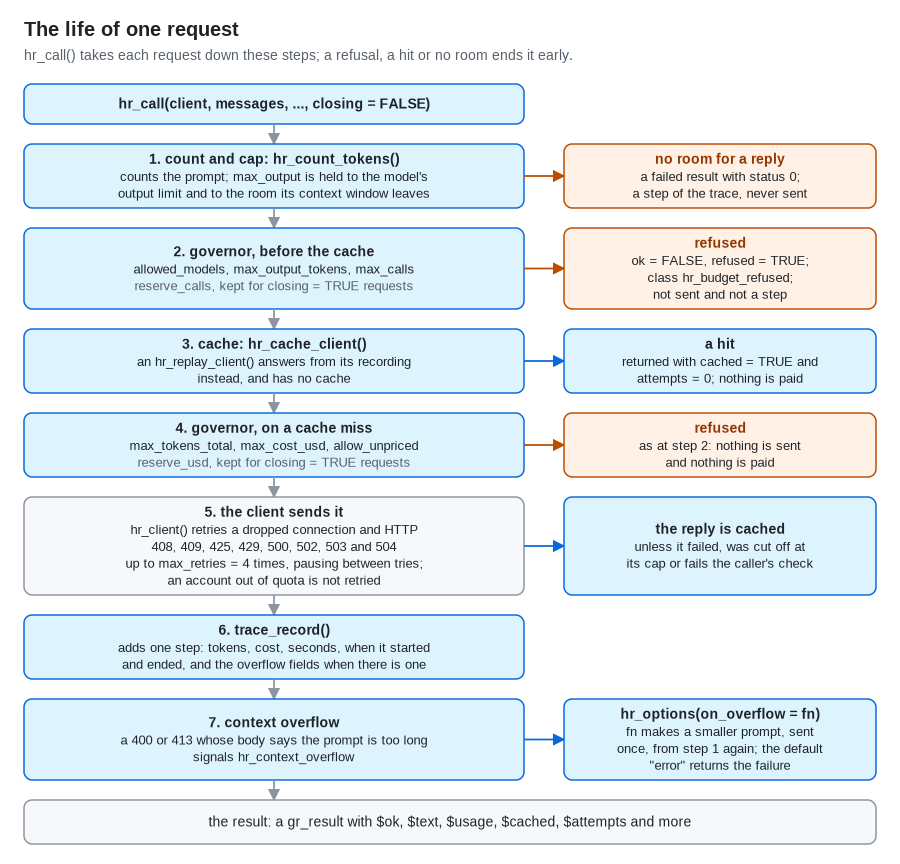
Before it sends anything, hr_call() does three
things:
- It counts the prompt’s tokens with the session’s tokenizer.
- It sets the reply’s cap,
max_output: the value you give, or the model’s own output limit, held to that limit and to the room the model’s context window leaves after the prompt. - It checks the request against the run’s limits (see Limits and refusals below). A request that would pass one is not sent.
The diagram follows one request from hr_call() to its
result, with the four places it can end early: no room for a reply, a
refusal at either governor check and a cache hit. The cache, the
recording and the trace each have a section further down.
Each call stands alone. harnessr keeps no conversation between calls,
so a second call sees only the messages you pass it. To continue a
conversation, pass the earlier turns again as "assistant"
and "user" messages.
hr_call() has a few more arguments, each covered further
down: trace and label record the call,
schema and schema_name ask for a structured
reply, temperature sets the sampling temperature,
effort the reasoning effort, and draw_index
marks repeated draws of one request. Named arguments it does not know go
into the request body of an hr_client() as extra fields; a
mock or a backend handler never sees them.
effort reaches only a model the registry lists as a
reasoning model. For any other model the call goes out with no effort,
and no warning:
effort_seen <- hr_mock_client(function(messages, params) {
  paste("effort:", if (is.null(params$effort)) "none" else params$effort)
})
hr_call(effort_seen, "What was revenue?", model = "gpt-5.6-luna", effort = "low")$text
#> [1] "effort: low"
hr_call(effort_seen, "What was revenue?", model = "gpt-4o", effort = "low")$text
#> [1] "effort: none"
vignette("effort") covers effort in full: the levels, an
effort per stage, what it costs, and effort that rises only when a stage
goes wrong.
What a result holds
A call returns a gr_result, a list with the same fields
every time, whichever client answered:
str(unclass(res), give.attr = FALSE)
#> List of 14
#>  $ ok           : logi TRUE
#>  $ text         : chr "Revenue was 45.2 million dollars."
#>  $ error        : NULL
#>  $ status       : int NA
#>  $ usage        :List of 3
#>   ..$ input     : int 12
#>   ..$ output    : int 13
#>   ..$ provenance: chr "estimated"
#>  $ model        : chr "mock-model"
#>  $ finish_reason: chr NA
#>  $ retryable    : logi FALSE
#>  $ raw          : NULL
#>  $ cached       : logi FALSE
#>  $ served_model : chr NA
#>  $ response_id  : chr NA
#>  $ fingerprint  : chr NA
#> $ attempts : int 1| Field | What it holds |
|---|---|
ok |
TRUE when a usable reply came back. FALSE
for a failed request, an error from the provider, and a reply with no
text. |
text |
The reply, one string. "" when ok is
FALSE, never NULL. Line breaks are kept. |
error |
What went wrong, or NULL. |
status |
The HTTP status. NA when the client gave none, as a
mock or a handler usually does, and 0 when no request was
sent (a refusal, a prompt that leaves no room for a reply). |
usage |
input and output tokens, and
provenance: "reported" by the provider,
"counted" here with the "tiktoken" tokenizer
or as a zero for a request that failed or was not sent, or
"estimated" with another tokenizer. reasoning
and cached_input appear when the provider reports them, as
parts of output and input. |
model |
The model the call asked for. Prices, the cache and a replay look the call up by it. |
finish_reason |
Why the reply ended. "length" means it was cut off at
the output cap, whatever the provider called it. NA when
the client reports none, as the mock above does. |
retryable |
Whether trying the same request again could help (a rate limit, a server error). |
raw |
The parsed response body from an hr_client(),
NULL from a handler or a cache. |
cached |
TRUE when an hr_cache() or a replay
answered, so nothing was paid. |
served_model, response_id,
fingerprint
|
What the provider said about its reply: the model that answered, its
response id and its system fingerprint. NA where it said
nothing. |
attempts |
Requests sent for this reply, retries included. 0 for a reply from a
cache or a recording, NA when the transport does not
say. |
A request the run’s limits stopped also has
refused = TRUE and the condition in
refusal.
When a call fails
A failed call returns a result too. It does not stop your script, so
a loop over many prompts keeps going when one request fails. A handler
that raises an error gives ok = FALSE with the message in
error:
down <- hr_mock_client(function(messages, params) stop("network down"))
bad <- hr_call(down, "What was revenue in 2024?")
bad
#> <gr_result> ok=FALSE model=mock-model in=12 out=0 error=network down
bad$text
#> [1] ""
A reply with no text is a failure too. Providers send an empty reply
for a refusal or a content filter, and hr_call() reports it
with ok = FALSE and finish_reason = "empty",
so an empty string never passes as an answer. The mock’s
mode argument makes it misbehave the way a provider can;
"refuse" sends empty replies:
refusing <- hr_mock_client(function(messages, params) "unused", mode = "refuse")
r <- hr_call(refusing, "What was revenue in 2024?")
c(ok = r$ok, finish_reason = r$finish_reason, error = r$error)
#>                 ok      finish_reason              error
#>            "FALSE"            "empty" "empty completion"
A reply cut off at the output cap keeps ok = TRUE,
because its text is what the model wrote, but its
finish_reason is "length". Check for it
wherever you need the whole reply. mode = "at_cap" marks
every reply as cut off:
capped <- hr_mock_client(function(messages, params) "Revenue was", mode = "at_cap")
r <- hr_call(capped, "What was revenue in 2024?", max_output = 20)
r
#> <gr_result> ok=TRUE model=mock-model in=12 out=20 truncated
#> Revenue was
r$finish_reason
#> [1] "length"
Check a result in this order: ok first, then
finish_reason, then the text itself.
A mock given a vector of HTTP status codes answers call
i with the i-th status. Here the provider is
rate limited (429), then fails (500), then answers:
flaky <- hr_mock_client(function(messages, params) "Revenue was 45.2 million dollars.",
                        mode = c(429, 500, 200))
t(vapply(1:3, function(i) {
  r <- hr_call(flaky, "What was revenue in 2024?")
  c(ok = r$ok, status = r$status, retryable = r$retryable)
}, numeric(3)))
#>      ok status retryable
#> [1,]  0    429         1
#> [2,]  0    500         1
#> [3,]  1     NA         0
The 429 and the 500 are marked retryable. The mock does
not retry, so each status costs one call. hr_client()
retries those statuses itself (see Retries and
timeouts).
Clients
A client is an R object you pass to each call. It is not a global setting, so two clients with two keys can work side by side in one R session. Each client is traced, held to the run’s limits, and can be cached and replayed; the sections below say where one kind differs. Four kinds of client send the request to a model or a function, one answers from a recording, and a cache can be attached to any of them.
A stand-in: hr_mock_client()
The mock answers with whatever its handler returns. The handler is a
function of messages, the list of messages sent, and
params, what the call asked for:
peek <- hr_mock_client(function(messages, params) {
  sprintf("%d message(s), model %s, cap %d tokens",
          length(messages), params$model, params$max_output)
})
hr_call(peek, msgs, max_output = 200)$text
#> [1] "2 message(s), model mock-model, cap 200 tokens"
str(peek$calls()[[1]]$params)
#> List of 6
#>  $ model        : chr "mock-model"
#>  $ max_output   : int 200
#>  $ temperature  : NULL
#>  $ schema       : NULL
#>  $ schema_name  : chr "result"
#>  $ prompt_tokens: int 21
$calls() lists every request the mock received, each
with its messages, params, result
and label, so a test can check the exact prompts your code
sent. $reset() empties the list and starts a
mode sequence again. The handler may return a string or a
gr_result, as a backend handler can (below).
A mock is for tests and practice, and it sends nothing off the
machine. Its calls cost nothing unless you give its model a price, as the trace section does below, and a mock’s model with
no price draws no hr_unpriced_model warning.
embed_handler gives it embeddings as well;
?hr_mock_client covers that and the other modes, including
"bad_json", which appears under Structured replies.
A function of your own: hr_backend_client()
hr_backend_client() turns any R function into a client:
a company proxy, a local model, a queue, another package’s client.
Register the model first, with its real context window and output limit,
since harnessr sizes every prompt from them. A price lets the spending
limit count its calls; a local model costs nothing, so register it at
zero:
hr_register_model("my-backend", context_window = 8000, max_output = 1000,
                  input_usd = 0, output_usd = 0)

echo <- function(messages, params) {
  question <- messages[[length(messages)]]$content
  sprintf("You asked: %s (reply cap %d tokens)", question, params$max_output)
}
bk <- hr_backend_client(echo, model = "my-backend")
bk
#> <gr_backend_client> model=my-backend embeddings=none (lexical fallback), 0 call(s) made
hr_call(bk, "What was revenue in 2024?", max_output = 100)
#> <gr_result> ok=TRUE model=my-backend in=12 out=21
#> You asked: What was revenue in 2024? (reply cap 100 tokens)
params carries model,
max_output, temperature, schema,
schema_name and prompt_tokens, and
effort and draw_index when the call has them.
What the handler does with them is up to it.
A handler that returns a string gets its token counts estimated. One
that knows the real counts can return a gr_result-shaped
list instead, with ok, text,
usage and any other field from the table above:
reporting <- hr_backend_client(function(messages, params) {
  structure(list(ok = TRUE, text = "Revenue was 45.2 million dollars.",
                 usage = list(input = 120L, output = 9L, provenance = "reported"),
                 finish_reason = "stop"),
            class = "gr_result")
}, model = "my-backend")
r <- hr_call(reporting, "What was revenue in 2024?")
str(r$usage)
#> List of 3
#>  $ input     : int 120
#>  $ output    : int 9
#>  $ provenance: chr "reported"
A backend does not retry: a handler that fails returns a failed
result, and only the handler can know whether trying again would help. A
cache cannot tell two handlers apart, so each backend client gets a new
identity when it is built, and its cache entries last only for the
session. Pass id = a stable name to reuse a cache across
sessions, and only for a handler that answers the same way every
time.
An HTTP provider: hr_client()
hr_client() talks to an OpenAI-compatible endpoint, on
the Responses API (api = "responses", the default) or Chat
Completions (api = "chat"). Building one sends nothing and
needs no key yet, and printing one hides the key:
oa <- hr_client(model = "gpt-5.6-terra", api_key = "sk-example", timeout = 30)
oa
#> <gr_client> model=gpt-5.6-terra api=responses base_url=https://api.openai.com/v1
#>   auth: bearer key (hidden)
#>   embeddings=text-embedding-3-small timeout=30s retries=4 cache=none
The call itself needs a real key and the network, so it is not run here:
live <- hr_client(model = "gpt-5.6-terra")   # the key comes from OPENAI_API_KEY
res <- hr_call(live, "What was revenue in 2024?", max_output = 200)
res$served_model
res$usage
hr_client() reads its defaults from
hr_options() when you build it: the model,
api, the base URL, headers, retries and the timeout.
Changing an option afterwards does not change a client you already
built. Build it again, or pass the value as an argument. For a gateway
that needs its own headers, pass headers =;
vignette("harnessr") covers gateways and keys.
Any provider ellmer supports: hr_ellmer_client()
hr_ellmer_client() takes a chat object from the ellmer package, so Anthropic,
Google, Bedrock, Ollama and the other providers ellmer supports answer
your calls. ellmer is optional, and this example needs it and a key, so
it is not run here:
library(ellmer)

# Illustrative figures, in USD per million tokens: use your provider's current
# prices.
hr_register_model("claude-sonnet-4-5", context_window = 200000, max_output = 64000,
                  input_usd = 3, output_usd = 15)
claude <- hr_ellmer_client(chat_anthropic(model = "claude-sonnet-4-5"))
hr_call(claude, "What was revenue in 2024?")$text
Each call runs on a fresh copy of your chat with its turns cleared,
so no history passes from one call to the next and your chat object is
left as it was. Three settings belong to the chat and not to the call:
the temperature and the reasoning effort are those the chat was built
with (a call that asks for another warns once), and the output cap
carries over only with ellmer 0.5.0 or later.
?hr_ellmer_client lists what carries over. A
temperature in a document read spec is ignored the same
way, with a warning.
The chat is priced as the model it was built with, so register that
model’s prices (“A model with no price” in
vignette("models")). Embeddings come from a function you
pass as embed =. Without one, retrieve and the
semantic segmenter fall back to lexical vectors and
warn.
A cache: hr_cache_client()
hr_cache_client() attaches an hr_cache() to
any client. A request answered once is answered from disk the next time,
at no cost:
n <- 0
counting <- hr_mock_client(function(messages, params) {
  n <<- n + 1
  "Revenue was 45.2 million dollars."
})
cache <- hr_cache(file.path(tempdir(), "core-guide-cache"))
cached <- hr_cache_client(counting, cache)

first <- hr_call(cached, "What was revenue in 2024?")
second <- hr_call(cached, "What was revenue in 2024?")
c(first = first$cached, second = second$cached)
#>  first second
#>  FALSE   TRUE
n
#> [1] 1
hr_cache_stats(cache)[, c("entries", "hits", "misses", "writes")]
#>   entries hits misses writes
#> 1       1    1      1      1
The handler ran once. The second result says
cached = TRUE and attempts = 0, and a trace
counts it as a call that cost nothing. The key is the exact request: the
messages, the model, the output cap, the temperature, the schema, the
effort, any extra body fields and the draw index, with the client’s
identity. Change any of them and the call misses.
A failed reply is never stored, and neither is a reply cut off at its
cap, so running again asks again. hr_cache() keeps its
entries under tempdir() unless you give it a directory or
set hr_options(cache_dir =), so by default a cache lasts
only for the session. hr_cache_clear() empties one and
returns the number of entries it removed, invisibly, so
hr_cache_stats() shows the result:
hr_cache_clear(cache)
hr_cache_stats(cache)[, c("entries", "hits", "misses", "writes")]
#>   entries hits misses writes
#> 1       0    0      0      0
Every count is back to 0. entries is read from disk, and
the clear also resets the session’s counts of hits,
misses and writes.
“Paying once” in vignette("runs") covers keeping a cache
across sessions, sampled calls and older caches.
A recording: hr_replay_client()
hr_replay_client() answers from a recorded trace instead
of a model (traces are the next section). Give it the trace of a run, or
the file hr_trace_save() wrote, and the same calls get the
same replies, with no key, no network and no spend:
tr <- hr_trace()
orig <- hr_call(cl, "What was revenue in 2024?", trace = tr)
f <- tempfile(fileext = ".json")
hr_trace_save(tr, f)

rp <- hr_replay_client(f)
again <- hr_call(rp, "What was revenue in 2024?")
identical(again$text, orig$text)
#> [1] TRUE
rp$stats()
#>   recorded distinct hits repeats misses legacy_hits
#> 1        1        1    1       0      0           0
$stats() counts the recording and its use:
recorded is the requests the trace holds,
distinct the different requests among them,
hits the calls it answered, repeats the hits
that reused the last reply, misses the calls it could not
answer, and legacy_hits the hits matched by an older
key.
A replay matches each call on its messages, its model, its effort,
its temperature, its output cap and its schema. A call the recording
does not hold stops with an error of class gr_replay_miss,
since the run no longer matches the recording:
tryCatch(hr_call(rp, "What was profit in 2024?"),
         gr_replay_miss = function(e) "not in the recording")
#> [1] "not in the recording"
strict = FALSE returns a failed result for a miss
instead. A call made more often than the recording made it raises
hr_replay_exhausted, unless you pass
on_exhausted = "flag", which repeats the last reply and
counts it in $stats()$repeats. A trace does not keep
embedding vectors, so a run that embedded replays only under conditions
that “Replaying a run” in vignette("runs") sets out, with
the limits a replay is held to.
The trace
A trace is the record of a run. Make one with hr_trace()
and pass it to each call as trace =; label =
names what the call was for:
# Illustrative prices for a stand-in model. For a real model, use your
# provider's current prices.
hr_register_model("priced-mock", context_window = 128000, max_output = 4096,
                  input_usd = 2, output_usd = 8)

tr <- hr_trace(purpose = "core guide")
a <- hr_call(cl, "What was revenue in 2024?", model = "priced-mock",
             trace = tr, label = "draft")
b <- hr_call(cl, "Check the draft against the report.", model = "priced-mock",
             trace = tr, label = "check")
tr
#> <gr_trace run_20261127174437.222_338a22>  2 steps, 2 model calls, 23 in / 26 out tokens, 0 error(s)
#>   steps: check x1, draft x1
#>   cost: $0.0003 across priced-mock, prices as of 2026-11
#>   time: 0.00 s (requests 54%, local 0%, overhead 46%)
#>   usage: estimated locally for 100% of requests (the provider reported none)
#>   actor: purpose = core guide
#>   started: 2026-11-27T17:44:37.222Z
The trace is an environment, so every call that is passed it records into the same object, and you need not collect it from each result. Printing it gives the number of steps and calls, the tokens, the errors, the cost by model, the share of token counts that were estimated, and who the run is for.
as.data.frame() gives one row per request:
as.data.frame(tr)[, c("step", "stage", "model", "ok", "cached",
                      "tokens_in", "tokens_out", "usd")]
#>   step stage       model   ok cached tokens_in tokens_out      usd
#> 1    1 draft priced-mock TRUE  FALSE        12         13 0.000128
#> 2    2 check priced-mock TRUE  FALSE        11         13 0.000126
The stage column is the label. The data frame also holds
the time, the error, the prompt and the reply of each request, and where
its price came from. Each row’s step points to the full
record in tr$steps:
step <- tr$steps[[1]]
names(step)
#>  [1] "step"          "label"         "at"            "started_utc"
#>  [5] "ended_utc"     "model"         "ok"            "cached"
#>  [9] "prompt"        "response"      "error"         "tokens"
#> [13] "seconds"       "attempts"      "served_model"  "response_id"
#> [17] "fingerprint"   "finish_reason" "params"        "budget_usd"
#> [21] "params_sent"   "replay_key"
str(step$params_sent)
#> List of 9
#>  $ model          : chr "priced-mock"
#>  $ api            : chr "mock"
#>  $ base_url       : chr "mock://"
#>  $ max_output     : int 4096
#>  $ temperature    : num NA
#>  $ effort         : chr NA
#>  $ schema_name    : chr NA
#>  $ schema_hash    : chr NA
#>  $ extra_body_hash: chr NA
params is what the call asked for, and
params_sent the request as it went out with every default
filled in. replay_key is the key a replay looks the call up
by. ?hr_trace describes every field.
hr_trace_summary() gives the totals in one row, and
hr_trace_cost() the cost by model:
hr_trace_summary(tr)[, c("calls", "cached", "tokens_in", "tokens_out", "errors",
                         "usage_estimated")]
#>   calls cached tokens_in tokens_out errors usage_estimated
#> 1     2      0        23         26      0               1
hr_trace_cost(tr)[, c("model", "calls", "paid_calls", "usd", "priced", "as_of")]
#>         model calls paid_calls      usd priced   as_of
#> 1 priced-mock     2          2 0.000254   TRUE 2026-11
The prices above are illustrative, so the dollar figures are too. A
mock reports no token counts, so every count here was estimated, and
usage_estimated is 1. A provider’s own counts are marked
"reported".
The summary also says how long the run took and where the time went:
hr_trace_summary(tr)[, c("elapsed_s", "request_s", "local_s", "overhead_s",
                         "request_share", "overhead_share")]
#>   elapsed_s request_s local_s overhead_s request_share overhead_share
#> 1         0         0       0          0        0.5384         0.4616
elapsed_s runs from the trace’s start to the end of its
last step, read from the steps, so a summary taken tomorrow, or of a
trace saved with saveRDS() and read back in another time
zone, gives the same figure. A local step’s time has no offset, so the
trace places it by the offset its requests show, or by the
utc_offset that hr_trace() recorded. An empty
trace gives 0. request_s is the seconds the requests took,
local_s the seconds that local steps timed (a command step
times itself), and overhead_s the rest: R code between
requests, and local steps that record no time. The shares add to 1.
Requests sent in parallel overlap, so request_s can pass
elapsed_s; the overhead is then 0. The print shows the same
split on its time: line, followed by the share of input
tokens the provider served from its cache when it served any.
hr_trace_save() writes the trace as JSON, the form
as_json() returns, and hr_replay_client()
reads that file. The file holds every prompt and reply, so treat it as
you would the documents the run read.
Who a run is for
A trace records five fields about who ran it and why:
system, owner, run_by,
purpose and approved_by. Give them to
hr_trace(), or set them once for every trace with
hr_options(actor =); a field set in neither place is
NA:
tr2 <- hr_trace(owner = "finance team", run_by = "ana", purpose = "Q3 check")
tr2$actor
#> $system
#> [1] NA
#>
#> $owner
#> [1] "finance team"
#>
#> $run_by
#> [1] "ana"
#>
#> $purpose
#> [1] "Q3 check"
#>
#> $approved_by
#> [1] NA
tr2$config keeps the options in force when the trace was
made and the R version, without the values of api_headers,
which can hold credentials.
Limits and refusals
Every request is checked against the run’s limits before it is sent.
By default a run may spend $5 and make 400 calls
(hr_options(max_cost_usd =, max_calls =)), and a trace
built with hr_governor() holds its own. A request that
would pass a limit is not sent:
small <- hr_trace(governor = hr_governor(max_calls = 1))
one <- hr_call(cl, "What was revenue in 2024?", trace = small)
two <- hr_call(cl, "What was profit in 2024?", trace = small)
c(ok = two$ok, refused = two$refused)
#>      ok refused
#>   FALSE    TRUE
small$stop_reason
#> [1] "calls"
The refused request comes back with ok = FALSE and
refused = TRUE, after a condition of class
hr_budget_refused is signalled, which you can catch with
withCallingHandlers(). It is not a step of the trace;
small$refusals lists it with the limit it would have
passed. vignette("runs") covers every limit.
Structured replies
To get data back rather than prose, pass schema, a JSON
Schema written as an R list, and schema_name.
hr_client() sends it as the provider’s structured output
setting, and a handler finds it in params$schema:
revenue_schema <- list(
  type = "object",
  properties = list(revenue_musd = list(type = "number"),
                    year = list(type = "integer")),
  required = list("revenue_musd", "year"),
  additionalProperties = FALSE)

json_mock <- hr_mock_client(function(messages, params) {
  if (is.null(params$schema)) "Revenue was 45.2 million dollars."
  else '{"revenue_musd": 45.2, "year": 2024}'
})
res <- hr_call(json_mock, "What was revenue, and for which year?",
               schema = revenue_schema, schema_name = "revenue")
res$text
#> [1] "{\"revenue_musd\": 45.2, \"year\": 2024}"
str(jsonlite::fromJSON(res$text))
#> List of 2
#>  $ revenue_musd: num 45.2
#>  $ year        : int 2024
The reply is still text. hr_call() does not parse it or
check it against the schema, so parse it yourself and handle a reply
that does not parse. Providers can send one, and
mode = "bad_json" makes the mock send JSON cut off part
way:
broken <- hr_mock_client(function(messages, params) "unused", mode = "bad_json")
res <- hr_call(broken, "What was revenue?", schema = revenue_schema)
res$ok
#> [1] TRUE
tryCatch(jsonlite::fromJSON(res$text), error = function(e) "does not parse")
#> [1] "does not parse"
The call succeeded, so ok is TRUE; the text
is the problem. Since hr_call() does not parse the reply,
an hr_cache() stores this one like any other, and a re-run
through the cache gets the same broken text back. Inside an arm of a
benchmark, ctx$call_json() does the parsing: it returns the
reply as a list when it meets the schema, a failed result when it does
not, and does not cache a reply that fails (?hr_arm).
Through ellmer, a schema ellmer cannot express is sent as an instruction
in the prompt instead, with a warning of class
gr_ellmer_schema.
Checking settings: hr_param(), hr_schema()
and hr_validate()
A second kind of schema checks settings, not replies.
hr_param() declares one setting, hr_schema()
collects them, and hr_validate() checks a list of values
against them. Use it for the settings of your own steps and modules:
reply_settings <- hr_schema(
  hr_param("max_words", "integer", default = 50L, min = 1, max = 500,
           help = "Longest reply, in words."),
  hr_param("style", "enum", choices = c("plain", "bullets"),
           help = "How the reply is laid out."))
reply_settings
#> <hr_schema> 2 parameter(s)
#>   max_words                  integer       basic     -         [1, 500]
#>   style                      enum          basic     -         plain|bullets
str(hr_validate(reply_settings, list(style = "bullets")))
#> List of 2
#>  $ max_words: int 50
#>  $ style    : chr "bullets"
The print gives one line per setting: its name, its type, its tier
("basic" or "advanced", for grouping the
settings in an interface), the status of the evidence for its default
(- when none is declared) and its bounds or choices.
A value left out gets its default. A number out of range moves to the
nearest bound with a gr_clamped warning, and a name the
schema does not have is an error of class
hr_unknown_param:
tryCatch(hr_validate(reply_settings, list(max_word = 10)),
         hr_unknown_param = function(e) conditionMessage(e))
#> [1] "'max_word' not a parameter of this schema. Parameters: max_words, style."
The spec constructors of the document layer,
gr_read_spec(), gr_segment_spec() and
gr_ingest_spec(), check their arguments against schemas
built the same way. A bound can depend on another setting.
hr_validate() resolves the parameters in schema order, so a
parameter whose bound depends on another, such as
overlap_tokens below, comes after it:
chunk_settings <- hr_schema(
  hr_param("max_tokens", "integer", default = 1200L, min = 32, max = 1e6,
           help = "Largest chunk, in tokens."),
  hr_param("overlap_tokens", "integer", default = 0L, min = 0,
           max = function(p) p$max_tokens - 1L,
           help = "Tokens repeated between neighbouring chunks."),
  hr_param("order", "enum", choices = c("relevance", "document"),
           help = "How chosen chunks are ordered in the prompt."))
chunk_settings
#> <hr_schema> 3 parameter(s)
#>   max_tokens                 integer       basic     -         [32, 1e+06]
#>   overlap_tokens             integer       basic     -         [0, f()]
#>   order                      enum          basic     -         relevance|document
The gr_clamped warning also has class
hr_param_clamped. An enum is matched as
match.arg() matches, so an unambiguous abbreviation is
accepted:
withCallingHandlers(
  str(hr_validate(chunk_settings,
                  list(max_tokens = 100, overlap_tokens = 500, order = "doc"))),
  gr_clamped = function(w) {
    message(conditionMessage(w))
    invokeRestart("muffleWarning")
  })
#> `overlap_tokens` 500 is outside [0, 99]; using 99.
#> List of 3
#>  $ max_tokens    : int 100
#>  $ overlap_tokens: int 99
#>  $ order         : chr "document"
A value outside an enum’s choices raises an error of
class gr_bad_setting that names the choices.
The types are integer, number,
string, boolean, enum,
string_vector, named_map,
module_ref and file; ?hr_param
gives the rule for each. For a parameter that needs a rule of its own, a
resolve function replaces the type’s rule.
The other fields describe the parameter and do not check it:
-
help: one plain sentence. -
cost_class: how it moves the cost of a run, one of"none","local","per_call_constant","per_unit","per_sample"or"per_round". -
affects_output: whether it belongs in cache and store keys. -
tier:"basic"or"advanced", for grouping in a user interface. -
evidence,depends_onandsince.
These fields let a later UI or command line be built from the same list.
Checking a reply
The checks in R come first: ok, then
finish_reason, then whether the text parses or says what it
should. For a check that needs a program, such as running code a model
wrote, hr_step_command() builds a step that runs a command
you name and reads its result as "passed" or
"failed". Here a model writes R code, and the step runs it
with Rscript:
coder <- hr_mock_client(function(messages, params) {
  "total <- sum(c(12.1, 15.3, 17.8))\nstopifnot(abs(total - 45.2) < 1e-9)"
})
code <- hr_call(coder, "Write R code that adds up the quarterly revenue and checks it.")

rscript <- file.path(R.home("bin"), "Rscript")
run_code <- hr_step_command("run", function(input, ctx) {
  f <- tempfile(fileext = ".R")
  writeLines(input$code, f)
  c(rscript, f)
})
out <- run_code(list(code = code$text), list())
out$check[c("status", "exit")]
#> $status
#> [1] "passed"
#>
#> $exit
#> [1] 0
A step is a function of its input and a context; called by hand, as
here, the context can be an empty list. The step returns its input with
the result added as check. Code that fails its own check
exits with an error, so the step reads it as "failed" and
keeps what the program printed:
wrong <- run_code(list(code = "stopifnot(sum(c(12.1, 15.3)) == 45.2)"), list())
wrong$check$status
#> [1] "failed"
cat(wrong$check$stderr)
#> Error: sum(c(12.1, 15.3)) == 45.2 is not TRUE
#> Execution halted
You write the command. harnessr never takes one from a model’s reply,
never chooses one, and does not isolate the program: it runs with your
permissions. The step sends no request, so it costs nothing.
parse = "testthat" reads a testthat summary line together
with the exit code: "passed" needs no failures and an exit
code of 0. No summary line, or no failures with a non-zero exit, gives
"error", as does a program that cannot be found.
timeout stops a program that runs too long, with the status
"timeout". “Checks that run a program” in
vignette("evaluate") covers those settings and how a
benchmark counts the results, and vignette("compose") puts
the step in a chain.
Credentials and the program
The program inherits your environment variables, less the ones that
look like credentials: names ending in _API_KEY,
_TOKEN, _SECRET, _PASSWORD,
_PAT or _SECRET_ACCESS_KEY, the common
provider variables, and any variable whose value is one of your
api_headers values, or the key you set with
options(harnessr.api_key =), of 8 characters or more. They
are unset for the call and put back after it, and a program that prints
one finds nothing:
Sys.setenv(DEMO_SERVICE_TOKEN = "tok-123456789", DEMO_REGION = "eu")
show_env <- hr_step_command("env", c(rscript, "-e",
  "cat(Sys.getenv('DEMO_SERVICE_TOKEN'), Sys.getenv('DEMO_REGION'), sep = '|')"))
show_env(list(), list())$check$stdout
#> [1] "|eu"
hr_options(command_hide_env =) adds patterns of your
own, such as "^DEMO_REGION$", and
command_temp_home = TRUE gives the program an empty
HOME for the call, so it does not read your configuration
files or stored logins. A command step’s note in the trace counts the
variables hidden as hidden_env, and never names them.
Output can still echo a key that a program read from a file, and an
HTTP error body can echo the key that was sent.
hr_options(mask_secrets = TRUE) replaces key-shaped strings
with <masked> in the output a command step keeps, in
the file hr_trace_save() writes and in a printed trace, and
counts what it replaced. In a command step’s output it also masks the
values of the variables the step hid. The trace in your session, the
cache and every key keep the text as it was. A later step that reads the
command’s $check gets the masked output, so a prompt built
from it changes with the setting:
prev <- hr_options(mask_secrets = TRUE)
leaky <- hr_step_command("leak", c(rscript, "-e",
  "cat('key: sk-proj-abcdefghijklmnopqrstuvwx and a plain sentence')"))
leaky(list(), list())$check$stdout
#> [1] "key: <masked> and a plain sentence"
hr_options(prev)
Sys.unsetenv(c("DEMO_SERVICE_TOKEN", "DEMO_REGION"))
Neither setting confines the program: it still runs with your
permissions. Masking is off by default so that traces and output stay
byte for byte what they were; turn it on before you share a trace file
or a step’s output. ?hr_options lists the shapes
masked.
Signals
A signal is a value your code records about its own work: whether the
code a model wrote ran, how sure a reply sounded, how long it was.
hr_signal() writes one into a trace, and
hr_signals() reads them all back as a table:
tr3 <- hr_trace()
code <- hr_call(coder, "Write the code.", trace = tr3)
out <- run_code(list(code = code$text), list())
hr_signal("demo.code_runs", out$check$status == "passed", tr3, item_id = "q1")
hr_signal("demo.reply_lines", length(strsplit(code$text, "\n")[[1]]), tr3,
          item_id = "q1")
hr_signals(tr3)[, c("step", "signal", "type", "item_id", "value", "score")]
#>   step           signal    type item_id value score
#> 1    2   demo.code_runs logical      q1  TRUE     1
#> 2    3 demo.reply_lines numeric      q1     2     2
score is the value as a number: 1 or 0 for a logical,
the number itself for a numeric value, and NA for text. A
value may be logical, numeric or text, and one call can record several
values. A signal is a local step of the trace: it is not a request, so
it adds no call and no cost and changes no cache key. Recording is all
it does. No signal changes what harnessr does unless you calibrate it
against labelled answers and set a threshold, which “Signals,
calibration and gate thresholds” in vignette("evaluate")
covers. hr_signals() also reads a list of traces and the
runs of a benchmark.
Errors and warnings by class
Every error and warning the core raises has a class, so you can catch
the one you expect and let the others through. Errors inherit from
gr_error and warnings from gr_warning:
tryCatch(hr_call(cl, "What was revenue?", draw_index = -1),
         gr_bad_setting = function(e) class(e))
#> [1] "gr_bad_setting" "gr_error"       "error"          "condition"
A failed request is not an error: it comes back as a result with
ok = FALSE. The classes below are the ones raised by the
functions this guide covers: a call, its clients, a trace, a schema and
a check. Benchmarks, chains and skills raise classes of their own, such
as hr_bad_arm and hr_unknown_setting; their
help pages (?hr_arm, ?hr_chain) and
vignette("compose") name them.
Errors:
-
gr_auth_error: no API key could be found, or the key holds a control character. A key with a control character also has the classgr_bad_key. -
gr_bad_setting,gr_bad_optionandhr_unknown_param: an argument, an option or a schema value that is not allowed. -
hr_bad_step: a step fromhr_step_command()built with a bad argument, or called with an input it cannot take. -
gr_file_not_found:hr_replay_client()given a trace file that does not exist. -
gr_header_error: a malformedheadersset forhr_client(). -
gr_bad_backend: an ellmer chat that lacks a method the adapter needs. -
gr_replay_miss,hr_replay_exhausted,gr_replay_unreadableandgr_replay_empty: a replay that diverged from its recording, ran past it, or could not read it. -
gr_bad_trace: something that is not a trace where one is needed. -
gr_budget_error: a prompt that cannot fit the model’s context window. -
gr_call_capandgr_cost_cap: limits that leave a benchmark’s reader, or an embedding request, too little before it starts. Both are also warnings when a batch of requests cannot all fit under the limits. -
gr_embed_error: an embedding request that failed where no fallback was allowed. -
gr_unknown_model(underunknown_model_action = "error") andhr_bad_models_file. -
gr_missing_dep: an optional package a feature needs is not installed.
Warnings:
-
gr_unknown_model: a model id the registry does not hold, under the defaultunknown_model_action = "warn". -
gr_clampedandhr_param_clamped: a setting moved to its nearest bound. -
gr_bad_setting: also a warning, whenhr_call()gets amax_outputthat is not one number and uses the model’s limit instead. -
gr_effort_unknown: an effort level harnessr does not know, sent as given. -
hr_unpriced_modelandhr_stale_price: a request to a model with no price, and a cost computed from old prices. -
hr_legacy_key: a cache or a replay that matched a reply by an older key. -
gr_ellmer_model,gr_ellmer_temperature,gr_effort_unsupported,gr_ellmer_max_outputandgr_ellmer_schema: a setting an ellmer chat cannot take per call.gr_ellmer_modelmeans a call named a model other than the one the chat was built with. -
gr_embed_fallbackandgr_backend_no_embeddings: embeddings replaced by word-overlap vectors, the second because the client has no way to embed. -
gr_parallel_unavailable:parallel = TRUEwithout the future and future.apply packages, so the work runs one item at a time.
Conditions that are neither: hr_budget_refused,
signalled for each request the limits stop, with
hr_model_not_allowed added when the model is not in
allowed_models, and hr_budget_stopped, the
warning a benchmark gives when its limits stopped runs.
hr_context_overflow is signalled when a provider refuses a
prompt as longer than the model’s window; the failed result carries the
same name in $error_class, and its $overflow
holds the local count of the prompt and the window.
vignette("context") shows it, and the
on_overflow option that retries such a request once with a
smaller prompt you make. A warning of class
hr_overflow_refit_failed says that function failed or gave
nothing hr_call() can send. vignette("runs")
lists the document layer’s classes.
API keys and options
hr_client() finds its key in this order: the
api_key argument, the harnessr.api_key option,
then the OPENAI_API_KEY environment variable.
hr_api_key() resolves a key the same way and stops with a
gr_auth_error that says how to set one when it finds none.
Given a key, it returns it with spaces and line breaks around it
dropped:
hr_api_key("  sk-example\n")
#> [1] "sk-example"
Called with no argument, it returns your real key, so do not print it
where others can see. A mock, backend or replay client needs no key.
“Connecting to a model” in vignette("harnessr") covers
where to keep a key and how to reach a company gateway.
hr_options() reads and sets the session’s options. With
one name it returns that option, with named values it sets them and
returns the old ones, and with no argument it returns them all:
hr_options("model")
#> [1] "gpt-5.6-terra"
prev <- hr_options(request_timeout = 60)
prev
#> $request_timeout
#> [1] 120
hr_options(prev)
?hr_options documents each option, and
vignette("settings") lists every setting with its default
and where the default came from.
Choosing the settings
Four walkthroughs cover the options a call reads: which model and endpoint it goes to, how it retries, its temperature, and who a trace says the run is for. Each says what the option controls, the signs that point to changing it, where its default came from, and how to test a change.
Model and endpoint: model, api,
api_base, api_headers and
embedding_model
What they control. They are the defaults
hr_client() takes when you build a client without naming
them: model the chat model, embedding_model
the embedding model, api the request shape
("responses" or "chat"), api_base
the address requests go to, and api_headers extra HTTP
headers. A call that names a model overrides the client’s.
The model also decides the limits a call is held to, from the model
registry:
unlist(hr_model_info(hr_options("model"))[c("context_window", "max_output")])
#> context_window     max_output
#>        1050000         128000
Signs they need changing. A
gr_unknown_model warning means the registry does not hold
the model. harnessr then takes its limits from a pattern that matches
the id, or from a default profile (a 128,000-token window and a
4,096-token output cap), and has no price for it, so register the model
with hr_register_model(). An error reply with status 404
can mean the endpoint does not serve the request shape api
names; an endpoint that offers only Chat Completions needs
api = "chat". A 401 or 403 from a gateway can mean it wants
its own headers in api_headers.
Where the defaults came from.
"gpt-5.6-terra", the Responses API and OpenAI’s address are
the package’s choice of a default provider. No measurement backs them,
and gr_settings_table("options") declares no evidence for
them.
How to test them. Two clients for two models are two
values, so you can compare them on the same prompts. A benchmark does
this with replicates and intervals (vignette("evaluate")).
Before any spend, check what each model takes:
models <- c("gpt-5.6-terra", "my-backend")
t(vapply(models, function(m) {
  unlist(hr_model_info(m)[c("context_window", "max_output")])
}, numeric(2)))
#>               context_window max_output
#> gpt-5.6-terra        1050000     128000
#> my-backend              8000       1000
Building a client sends nothing, so you can check what a client will send before it sends it. Here the options set a larger embedding model and a team header, and a client built with a placeholder key shows them:
prev <- hr_options(embedding_model = "text-embedding-3-large",
                   api_headers = c("X-Team" = "finance"))
hr_client(api_key = "sk-example")
#> <gr_client> model=gpt-5.6-terra api=responses base_url=https://api.openai.com/v1
#>   auth: bearer key (hidden), 1 extra header(s), values hidden: X-Team
#>   embeddings=text-embedding-3-large timeout=120s retries=4 cache=none
hr_options(prev)
The print names each extra header and hides its value, since a
gateway header can hold a credential. embeddings= is the
model hr_embed() asks for. A client argument
(model, api, base_url,
embedding_model, headers) overrides the option
for that client alone.
hr_embed() turns texts into vectors, one row per text,
through the client’s embeddings endpoint or the embed function it was
built with. A mock takes one as embed_handler:
embedding_mock <- hr_mock_client(embed_handler = function(texts, params) {
  m <- cbind(nchar(texts), 1)
  m / sqrt(rowSums(m^2))
})
e <- hr_embed(embedding_mock, c("Revenue rose.", "Costs fell sharply."))
dim(e)
#> [1] 2 2
attr(e, "embedding_source")
#> [1] "api"
The "embedding_source" attribute names the embedder that
made the rows: "api" for the client’s own, which here is
the handler. A client with no way to embed falls back to vectors of word
overlap, with a warning of class gr_backend_no_embeddings,
and the attribute says so:
plain <- hr_backend_client(function(messages, params) "unused")
e2 <- withCallingHandlers(
  hr_embed(plain, c("Revenue rose.", "Costs fell sharply.")),
  gr_backend_no_embeddings = function(w) invokeRestart("muffleWarning"))
attr(e2, "embedding_source")
#> [1] "lexical"
Check that attribute before you treat the rows as meaning:
word-overlap vectors rank texts by shared words.
fallback = "error" stops with gr_embed_error
instead. ?hr_embed covers batching, the cache and the
limits an embedding request is held to.
Retries and timeouts: max_retries,
retry_pause_base and request_timeout
What they control. hr_client() retries
a request that failed with a status worth retrying (408, 409, 425, 429,
500, 502, 503 and 504) or with no response at all, up to
max_retries times (4 by default). It waits a random time
between half and all of retry_pause_base times 2 to the
power of n - 1 after the n-th failed attempt. With the default of 2
seconds that is 1 to 2 seconds, then 2 to 4, then 4 to 8, at most 60
seconds, or what the provider’s Retry-After header says,
also at most 60 seconds. A 429 that says the account is out of quota is
not retried. request_timeout (120 seconds) is how long one
request may take. These apply to hr_client() alone: a
backend handler does its own retrying, and the mock does none.
Signs they need changing. A failed result with
retryable = TRUE means the retries ran out before the
provider answered; raise max_retries, or send fewer
requests at once. Many attempts above 1 in the trace’s
steps mean the run spends much of its time waiting on rate limits. A
request that fails with a transport error after
request_timeout seconds, on a long reply, needs a larger
timeout.
Where the defaults came from. They were set when the
HTTP client was written and have not been tuned;
gr_settings_table("options") lists them as untested.
How to test them. The mock reproduces a sequence of
statuses, so you can check how your code handles a failure without
waiting on a provider. Each step of a trace records its
attempts, so the trace of a real run shows how often a
retry was needed. The mock never retries, so each of its steps shows
one:
Sampling: temperature
What it controls. The sampling temperature a call
sends when the call does not give one. NULL, the default,
sends none, and the model uses its own default. hr_client()
sends no temperature to a model the registry lists as a reasoning model
or as not taking one. A mock or backend handler is given only the
temperature the call names, in params$temperature, not this
default.
Signs it needs changing. Replies to one prompt that differ from run to run when you need them to agree. Set a low temperature, or cache the reply so a re-run gets the same text. A cache key includes the temperature, so changing it misses every cached reply.
Where the default came from. NULL
leaves the choice to the model;
gr_settings_table("options") lists it as untested.
How to test it. Send the same request as several
draws, with draw_index 1 to N, and compare the replies.
Each draw is its own cache entry and its own replay entry, so the
comparison can be run again for nothing:
k <- 0
sampler <- hr_mock_client(function(messages, params) {
  k <<- k + 1
  sprintf("draw %d at temperature %s", k, format(params$temperature))
})
sampler <- hr_cache_client(sampler, hr_cache(file.path(tempdir(), "core-guide-draws")))
vapply(1:3, function(i) hr_call(sampler, "Pick a number.", temperature = 0.7,
                                draw_index = i)$text, "")
#> [1] "draw 1 at temperature 0.7" "draw 2 at temperature 0.7"
#> [3] "draw 3 at temperature 0.7"
vapply(1:3, function(i) hr_call(sampler, "Pick a number.", temperature = 0.7,
                                draw_index = i)$text, "")
#> [1] "draw 1 at temperature 0.7" "draw 2 at temperature 0.7"
#> [3] "draw 3 at temperature 0.7"
The second line came from the cache. A real model’s draws differ only as much as its temperature lets them.
Who a run is for: actor
What it controls. The five fields every new trace
records unless hr_trace() is given them:
system, owner, run_by,
purpose and approved_by. They change no
request and no key.
Signs it needs changing. Saved traces you cannot attribute to a person or a project, or a review that asks who approved a run.
Where the default came from. Empty, so a trace records only the fields you set.
How to test it. Set it once and check a new trace:
prev <- hr_options(actor = list(system = "core guide", owner = "finance team"))
hr_trace()$actor[c("system", "owner", "run_by")]
#> $system
#> [1] "core guide"
#>
#> $owner
#> [1] "finance team"
#>
#> $run_by
#> [1] NA
hr_options(prev)
Where the document layer builds on this
Every reading function in the document layer makes its chat requests
with hr_call() and its embedding requests with
hr_embed(), and records them in a trace, so everything
above applies to a whole document. answer_document() takes
the same clients and returns the trace of its run in
$trace; vignette("harnessr") starts there.
Next
-
vignette("models"): the model registry, setting prices, cost estimates and token counts. -
vignette("context"): how much room a prompt has, and what is cut when it does not fit. -
vignette("effort"): how hard a reasoning model reasons, call by call or stage by stage. -
vignette("runs"): limits, the governor, caching across sessions, and replaying a whole run. -
vignette("compose"): steps and chains built from calls like these, and a coding sub-agent that checks its own code. -
vignette("evaluate"): benchmarks, judges, checks that run a program, and calibrating signals. -
vignette("extending"): registering your own modules and checking them against the contract. -
vignette("settings"): every setting with its default.